One stack per client. One queue per stack. One person accountable for every action.
What the agent collects, what the detection engine does with it, what the console lets a person decide, and what the Zeroday SOC does on your behalf. Nothing below is aspirational — every screen is from a running stack.
From an endpoint to a human decision.
Catch it, and show your working.
4,519 detection rules
Loaded on every stack and counted, not estimated. 1,576 decoders turn raw logs into the fields the rules read. Rules carry ATT&CK technique mappings and compliance references — PCI DSS, GDPR, HIPAA, NIST 800-53.
File integrity monitoring
Changes to watched paths are recorded with what changed and when. The same engine that flagged a certificate tool's README as a ransom note had the rule corrected the same day — and that correction is in the audit trail.
Vulnerability scanning
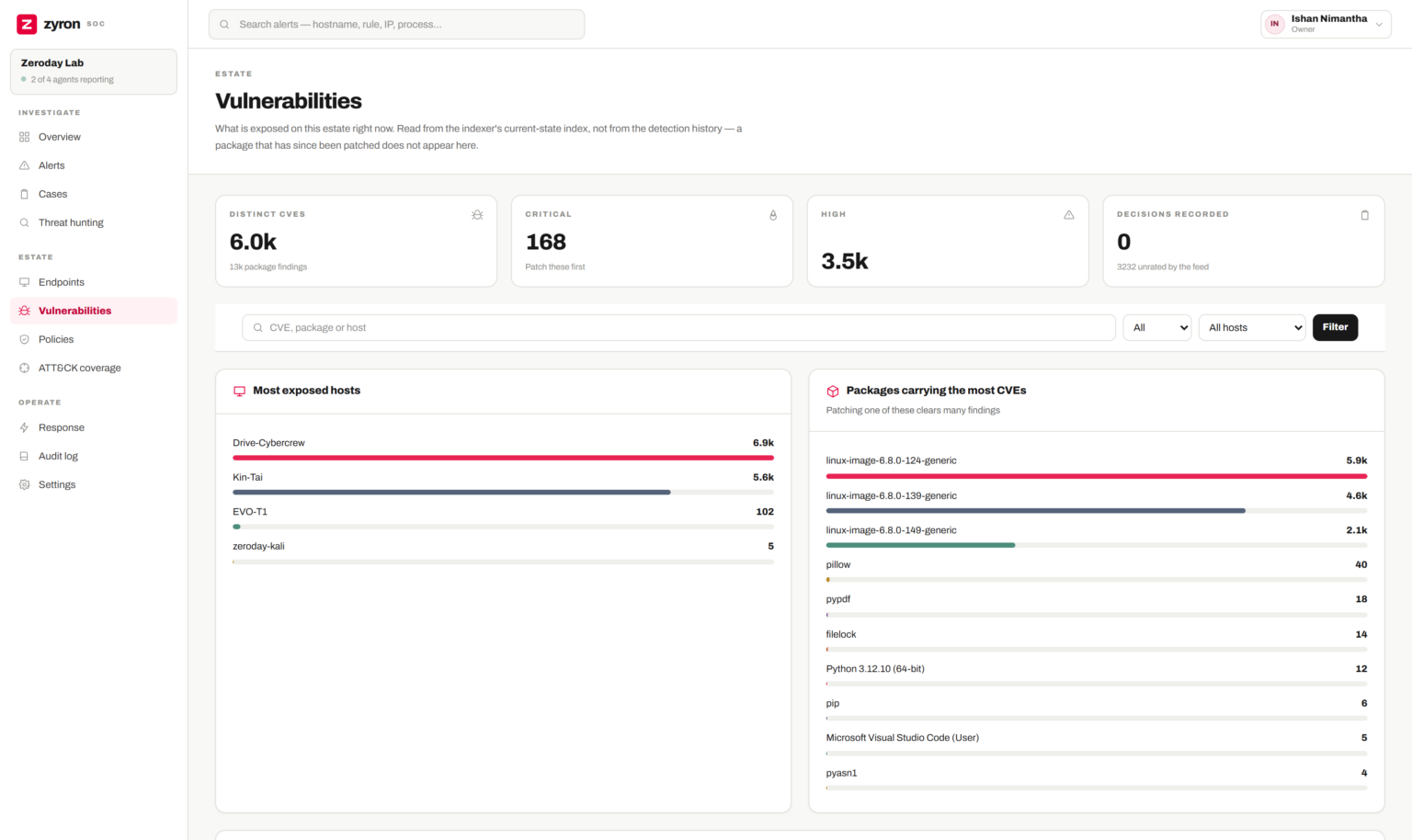
Installed packages matched continuously against CVE feeds. The console reads current state, not detection history, so a package that has since been patched does not appear — and the fix version is shown where the feed names one.
Hardening checks
CIS benchmarks run on each endpoint and report every failing control with its remediation text.
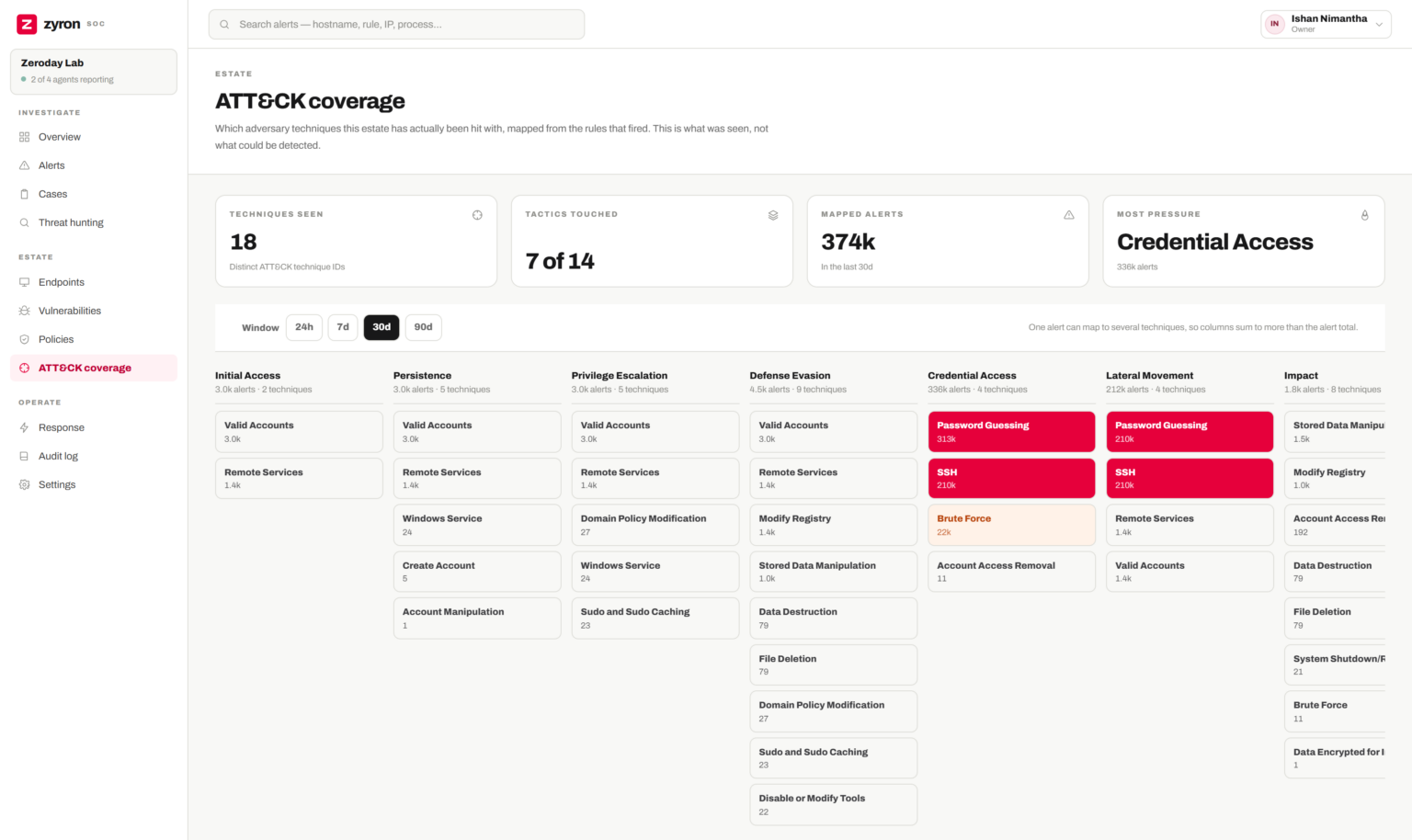
ATT&CK coverage
A matrix of what the estate has actually been hit with, in kill-chain order. Tactics with no alerts are listed as an absence of evidence, not as coverage.
Threat hunting
Query everything the stack has kept — every alert, 90 days hot — starting from a question rather than a blank box.
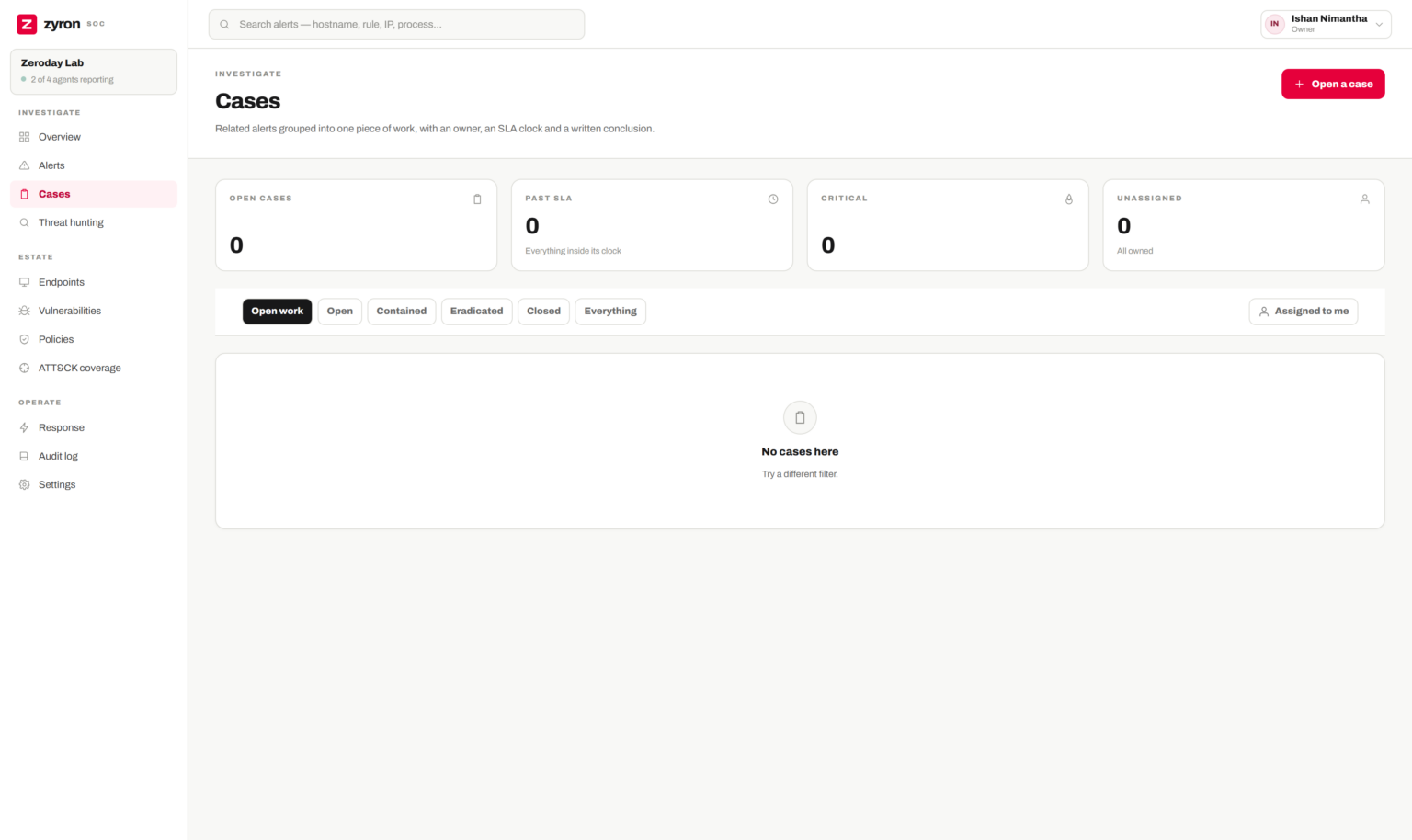
Cases, with a clock and a conclusion.
Related alerts become one piece of work with an owner and an SLA by severity — four hours for critical, a week for low. Notes build the written trail a client reads afterwards. Closing is refused until a root cause is recorded.
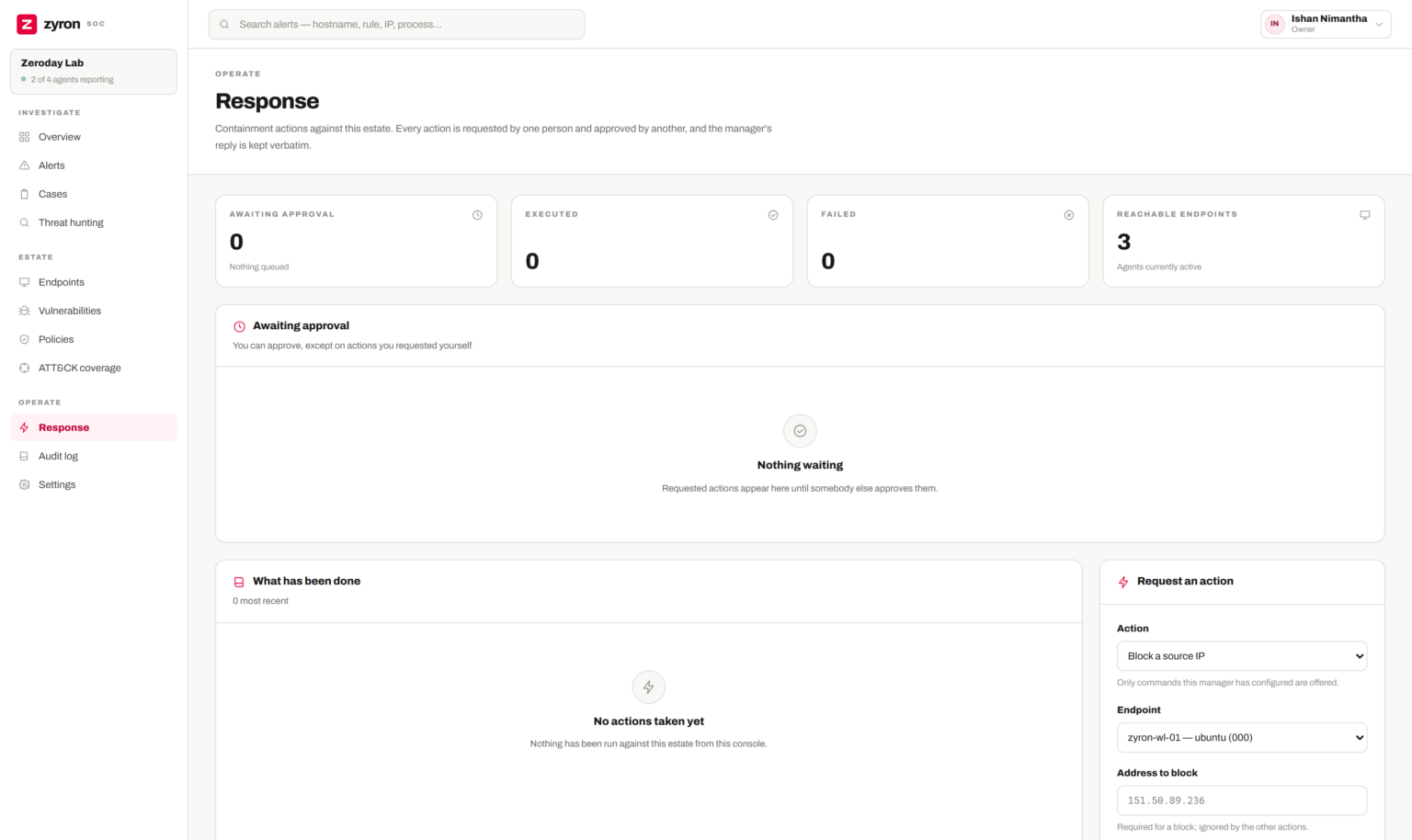
Act deliberately, with two sets of eyes.
Containment is requested by one person and approved by another. The stack’s reply is kept verbatim. The page lists, honestly, what this platform can do automatically, what it can do with approval, and what it cannot do at all.
- Automatic: intrusion detection, file integrity, vulnerability scanning, hardening checks
- With approval: block a source address, restart an agent
- Not available: stopping malware before it executes, full host isolation, inline network blocking, file quarantine
What is exposed right now.
Thousands of findings that never shrink are not a workflow. Each finding carries a decision — open, in progress, mitigated, accepted — held against the CVE, host and package so it survives every rescan, and the packages carrying the most CVEs are surfaced because patching one of them clears many.
Run it, or let Zeroday run it.
Every stack is self-sufficient. If you would rather not staff the night shift, Zeroday analysts work your queue under rules you set, through named accounts that are written to your audit log.
- One isolated stack per client — own server, own store, own credentials
- 90 days searchable on the stack; older data snapshotted to cold storage and restorable
- Append-only audit log: who did what, from where, including refused actions
- No self-service sign-up; accounts issued per stack
See it on a live stack.
The demo runs on synthetic data and is labelled as such. The product runs on yours.